
International Archives for the Jazz Organ
The Jazz Organ Scene
Ethiopia
 © Tore Sætre / Wikimedia http://www.setre.net/ |
Mulatu Astatke
Mulatu Astatke (aka Mulatu Astatqé) was born in 1943, in Jimma, Ethiopia. He is an Ethiopian musician, composer, arranger and multi-instrumentalist, widely regarded as the father of Ethio-jazz.
At the age of 16, Mulatu was sent to the United Kingdom, originally with the intention of studying aeronautical engineering. However, his growing interest in music led him to study at Trinity College of Music in London. He subsequently moved to the United States, where he attended Berklee College of Music in Boston, becoming the first African student to graduate from the institution. During his years in London and the United States, Mulatu absorbed influences from jazz, Latin music and African musical traditions. In the mid-1960s, he recorded his first albums, Afro-Latin Soul, Volumes 1 & 2, in New York. Combining traditional Ethiopian pentatonic scales with jazz harmonies, Latin rhythms, funk and soul, he developed a distinctive musical style that became known as Ethio-jazz. Returning to Ethiopia in the late 1960s, Astatke became one of the leading figures of Addis Abeba's vibrant music scene, often referred to as the "Swinging Addis" era. His recordings for Amha Records during the late 1960s and early 1970s helped establish a new direction in Ethiopian popular music. As a bandleader and instrumentalist, he introduced instruments such as the vibraphone and congas into Ethiopian popular music. His own instrumental palette includes vibraphone, piano, organ, keyboards and percussion. Throughout his career, Mulatu has collaborated with numerous internationally renowned musicians, including Mahmoud Ahmed and Duke Ellington. His music gained renewed international attention in 2005 when several of his compositions were featured in Jim Jarmusch's film Broken Flowers. This rediscovery brought his work to a new generation of listeners and inspired numerous musicians and producers to sample and reinterpret his recordings. Among his later projects are collaborations with the London-based group The Heliocentrics, resulting in the album Inspiration Information 3 (2009), and with Boston's Either/Orchestra. He has also worked with Australia's Black Jesus Experience, continuing to explore new musical territories. In 2012, Berklee College of Music awarded him an honorary doctorate in recognition of his contribution to music. His subsequent recordings include Mulatu Steps Ahead (2010), Sketches of Ethiopia (2013), To Know Without Knowing (2019) and Mulatu Plays Mulatu (2025), an album revisiting some of his best-known compositions. Mulatu remains one of the most influential figures in Ethiopian music and a pioneer whose distinctive fusion of African traditions, jazz and international influences has earned him worldwide recognition. created by ChatGPT |
| contact: | |
| homepage: |
|
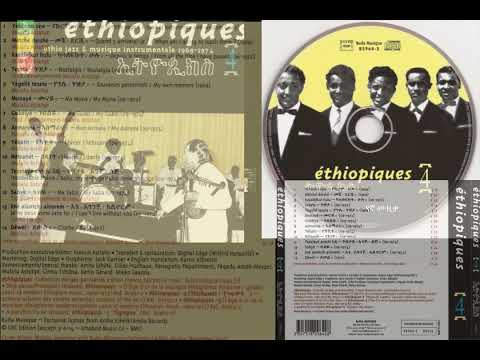
Éthiopiques 4 • Ethio Jazz & Musique Instrumentale 1969-1974 Buda Musique 82964 recorded 1969 through September 1974 |
Mulatu, keyboards, organ, Fender Rhodes Antonio, alto sax Fèqadu Amdé-Mesqel, tenor sax Mogus Habte, tenor sax Tesfa-Maryam Kidané, tenor sax Fèllèqè Kidané, trumpet Yohannès Tèkolla, trumpet Fèqadu Amdé-Mesqel, flute Tèklè "Huket" Adhanom, guitar Andrew Wilson, guitar Girma Bèyènè, piano Ivo, bass Haylu "Zihon" Kèbbèdè, bass Giovanni Rico, bass Tèmarè Harègu, drums Tesfayé "Hodo" Mèkonnen, drums Girma Zèmaryam, drums |
 |
n/a |
 |
n/a |
|
You can watch the video on the YouTube site by clicking on the corresponding picture. For more videos search YouTube |
|
|
|
Back
If you don't see the left hand menu,
please go back to the homepage.
Back to the homepage
International Archives for the Jazz Organ – curated by Jürgen Wolf, Köln/Germany.